
Copper IUD
What's on this page?
- What is the IUD?
- What are Copper IUDs?
- How effective are Copper IUDs?
- How can I get a Copper IUD?
- What's a Copper IUD insertion like?
- Are there Copper IUD side effects?
- How safe are Copper IUDs?
- What are the benefits of Copper IUDs?
- What are the disadvantages of Copper IUDs?
- How does Copper IUD removal work?
- What are Copper IUDs?
What is the IUD?
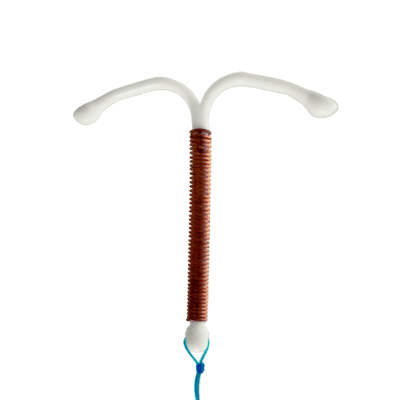
One Copper IUD (Paragard T380A) is approved for use in USA. It is a T-shaped device made of copper that is inserted into the uterus and causes an inflammatory response in its lining that weakens sperm action
What are Copper IUDs?
copper impedes sperm transport and viability in the cervical mucus. Because of these changes, very few, if any, sperm reach the oviducts, and the ovum usually does not become fertilized
The copper T380A has bands of copper on the cross arms of the T in addition to
the copper wire around the stem, providing a total surface area of 380 mm of
copper and approved for up to 10 years of continous use
How effective are Copper IUDs?
All IUDs provide safe, long-term contraception with effectiveness equivalent to tubal sterilization
How can I get a Copper IUD?
It must be inserted by a medical professional. Bimanual examination and cervical inspection are necessary before IUD placement
What's a Copper IUD insertion like?
It may be placed at any time if it is reasonably certain that the patient is not pregnant. It also may be placed within 5 days of the first act of unprotected sexual intercourse as an emergency contraceptive. Most insertions are straightforward and accomplished on the first attempt. Some patients might exoerience pain which can be reduced using topical lidocaine.
Are there Copper IUD side effects?
- Menstrual problems: heavier or longer menstrual bleeding, more intense cramps, irregular bleeding, or light spotting.
- Discomfort during insertion.
- IUD expulsion (rare).
- Uterine wall perforation (very rare).
How safe are Copper IUDs?
Very Safe except for those with comorbidities of US MEC 3-4 and those with copper allergy or Wilson's disease
What are the benefits of Copper IUDs?
IUDs are long-acting, are reversible, and can be used by patients of all ages, including adolescents, and by parous and nulliparous patients
it is a One-time procedures; nothing to do or remember
IUD use might be associated with a reduction in risk of developing cervical and endometrial cancer
What are the disadvantages of Copper IUDs?
- No STI protection.
- Spotting or light bleeding and heavy or prolonged bleeding is common during the first 3–6 months of use, (generally not harmful but might be bothersome, usually decreases with continued use).
- If a pregnancy occurs, the chances of ectopic pregnancy, abortion and infection are higher than those without IUD.
How does Copper IUD removal work?
Removing an IUD is usually simple— a doctor inserts a speculum and gently pulls on the string. If the string isn’t visible, they may use a cotton swab or a small tool to find and pull it out. In rare cases, if the IUD is stuck in the uterine wall, a specialized procedure with a camera (hysteroscopy) may be needed. In very rare cases, if the IUD has gone through the uterus, surgery (laparoscopy) may be required to remove it.
What are Copper IUDs?
A copper IUD is a small, T-shaped device made of plastic and wrapped in copper that a doctor places inside the uterus to prevent pregnancy. It works by releasing copper, which creates an environment that makes it difficult for sperm to survive and reach an egg. Unlike hormonal birth control, the copper IUD doesn’t use hormones, and it can last for up to 10 years. It’s one of the most effective birth control methods and can also be used as emergency contraception if inserted within 5 days after unprotected sex.
*This guide offers general advice. Please consult your provider for personal recommendations.